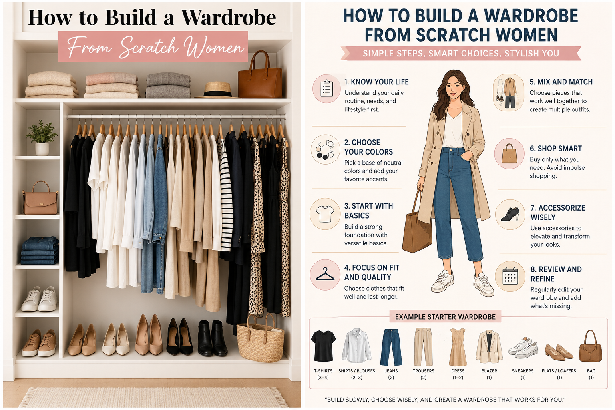
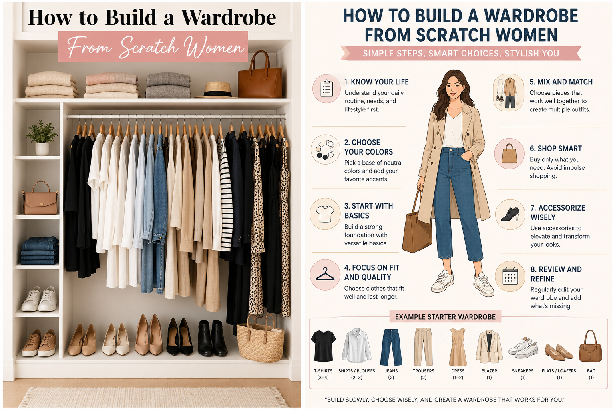
How to build a wardrobe from scratch women can feel hard when your closet is empty, messy, or full of clothes that do not work together. However, you do not need to buy everything at once. You need a clear plan.
A good women’s wardrobe should fit your real life. It should help you dress for work, weekends, family events, travel, relaxed days, and special occasions. Most importantly, your clothes should feel comfortable and make you feel like yourself.
This guide explains how to build a wardrobe from scratch women can actually use every day. You will learn what to buy first, how to choose colors, how to select the right fit, how to avoid waste, and how to create many outfits from a smaller number of pieces.
You will also find a practical wardrobe chart, real-life examples, advantages and disadvantages, expert advice, shopping tips, and 20 frequently asked questions.
The goal is simple: build a wardrobe that works for you instead of buying clothes simply because they look good on someone else.
How to Build a Wardrobe From Scratch Women: Start With Your Life
The first step is not shopping.
Instead, think about how you spend a normal week.
Do you work in an office? Do you work from home? Do you study? Do you care for children? Do you attend formal events often? Do you spend most of your time in casual clothes?
Your answers should guide your wardrobe.
For example, an office worker may need more trousers, blouses, cardigans, and smart shoes. On the other hand, someone who works from home may need more comfortable pants, simple tops, and easy layers.
Therefore, do not copy another woman’s closet.
Your wardrobe should solve your own clothing needs.
Write Down Your Weekly Clothing Needs
Before buying anything, make a simple list.
Write down the main situations you dress for:
- Work
- School or college
- Home
- Shopping
- Exercise
- Dinner
- Dates
- Family events
- Weddings
- Travel
- Outdoor activities
- Relaxing weekends
Then estimate how often each situation happens.
For example:
| Activity | Days per week | Clothing need |
| Work | 5 | High |
| Casual time | 6 | High |
| Exercise | 3 | Medium |
| Dinner | 1 | Medium |
| Formal events | 1 per month | Low |
| Travel | 1 per month | Medium |
This small exercise prevents random shopping.
How to Build a Wardrobe From Scratch Women Need for Real Life
A wardrobe works best when it reflects your lifestyle.
If you spend most of your time in jeans and sneakers, you probably do not need ten formal dresses.
Likewise, if you attend business meetings every day, five pairs of casual shorts will not solve your clothing needs.
A simple rule is useful:
Buy for the life you live, not the life you imagine.
That does not mean you cannot have special pieces. It simply means your everyday wardrobe should receive most of your attention.
Find Your Personal Style Before Shopping
Personal style does not need a fancy name.
You might like:
- Classic
- Casual
- Minimal
- Feminine
- Sporty
- Modern
- Bohemian
- Romantic
- Edgy
- Preppy
- Relaxed
- Elegant
You can also mix styles.
For example, you may like classic clothes with sporty shoes. Or perhaps you prefer feminine dresses with simple jackets.
The key is to notice what you naturally choose.
Look at your favorite outfits. Ask yourself what they have in common.
Do you like clean lines? Soft colors? Loose clothing? Fitted tops? Denim? Prints?
Your answers will help you shop with purpose.
Create a Simple Style Mood Board
A mood board can make your choices much easier.
Save around 15 to 30 outfit pictures that you genuinely like. Then look for patterns.
You may notice that you keep saving:
- Straight-leg jeans
- White shirts
- Neutral sweaters
- Long skirts
- Simple dresses
- Sneakers
- Gold jewelry
- Structured bags
That pattern tells you something about your style.
However, do not buy every item you see in your mood board.
Use the board as inspiration, not as a shopping list.
How to Build a Wardrobe From Scratch Women Can Afford
You do not need a huge clothing budget.
In fact, buying slowly can create a better wardrobe.
Start with the pieces you need most. Then add items over time.
A simple budget system could look like this:
- 50% for essential clothing
- 20% for shoes
- 15% for outerwear
- 10% for accessories
- 5% for fun pieces
You can change these numbers based on your lifestyle.
For example, someone living in a cold area may need to spend more on coats. Someone living in a warm climate may spend more on breathable tops and sandals.
Set a Shopping Limit Before You Begin
A shopping limit protects you from impulse buying.
Decide how much you can spend for the first month.
Then divide that money between priorities.
For example, with a $300 budget, you might buy:
- Two everyday tops
- One pair of jeans
- One pair of trousers
- One cardigan
- One pair of comfortable shoes
- One simple dress
You do not have to buy all six items if they do not fit your budget.
Quality and usefulness matter more than speed.
Learn the Difference Between Need and Want
This is one of the most important wardrobe skills.
A need solves a real clothing problem.
A want simply looks exciting.
For example:
Need: A black pair of pants for work.
Want: A bright pink sequin skirt because it looks fun online.
Both can have value. However, the need should usually come first.
Before buying something, ask:
- Can I wear it at least three ways?
- Does it fit my lifestyle?
- Do I already own something similar?
- Can I afford it?
- Will I still like it next year?
If the answers are mostly yes, the purchase may make sense.
How to Build a Wardrobe From Scratch Women Should Begin With Basics
Basics create the foundation of your wardrobe.
They do not have to be boring.
Good basics can include:
- T-shirts
- Tanks
- Button-down shirts
- Jeans
- Trousers
- Skirts
- Simple dresses
- Cardigans
- Blazers
- Jackets
- Comfortable shoes
Glamour’s 2026 capsule wardrobe guide also stresses that the best basics depend on each person’s lifestyle, preferred cuts, colors, and daily needs.
That is important because there is no single perfect wardrobe list for every woman.
Build Your Top Collection First
Tops give you many outfit choices.
A useful starting collection could include:
- Two neutral T-shirts
- One colorful T-shirt
- One tank top
- One button-down shirt
- One casual blouse
- One nicer blouse
- One sweater
- One cardigan
Choose colors that work with your bottoms.
For example, white, cream, navy, black, gray, brown, and denim can mix easily.
Then add one or two colors you love.
Choose Bottoms That Work Hard
Bottoms often create the base of an outfit.
Start with pieces you will actually wear.
Good choices may include:
- One blue pair of jeans
- One black or dark pair of jeans
- One pair of tailored trousers
- One casual pair of pants
- One skirt
- One pair of shorts if your climate requires them
You do not need every style.
If you hate skirts, do not buy five skirts because someone says they are essential.
Your wardrobe should make dressing easier.
How to Build a Wardrobe From Scratch Women Can Mix Easily
The best clothing pieces work with several other items.
Think about your wardrobe as a puzzle.
One white shirt can work with:
- Jeans
- Black pants
- A skirt
- Shorts
- Under a sweater
- Under a blazer
That makes the shirt more valuable than a top that works with only one outfit.
A useful rule is to ask:
Can this item make at least three outfits with clothes I already own?
If yes, it has strong wardrobe value.
Pick a Small Main Color Palette
Color makes mixing clothes much easier.
Start with two or three main neutral colors.
For example:
Palette A: Black, white, gray
Palette B: Navy, cream, brown
Palette C: Beige, white, denim
Then add two accent colors.
For example:
- Burgundy
- Green
Or:
- Pink
- Blue
You do not need to wear only neutral colors.
Instead, use neutrals as the base and colors as the fun part.
Use the Three-Color Outfit Rule
A simple styling trick is to keep most outfits within three main colors.
For example:
- Navy pants
- White shirt
- Brown shoes
Or:
- Blue jeans
- Cream sweater
- Burgundy bag
This does not mean every outfit must follow the rule.
Rather, it gives beginners an easy starting point.
Once you become more confident, you can play with more colors and patterns.
How to Build a Wardrobe From Scratch Women Should Use for Every Season
Your climate matters.
Someone living in a hot climate needs a very different wardrobe from someone living where winters are cold.
For warm weather, consider:
- Cotton tops
- Linen shirts
- Lightweight pants
- Skirts
- Dresses
- Sandals
- Light layers
For cold weather, consider:
- Sweaters
- Thermal layers
- Jeans
- Wool or warm coats
- Boots
- Scarves
- Gloves
For changing weather, layering becomes especially useful.
Choose Clothes for Your Body, Not a Rulebook
You do not need to dress according to strict body-type rules.
Instead, focus on fit and comfort.
Ask:
- Can I move easily?
- Does the waistband feel comfortable?
- Does the shoulder fit?
- Does the fabric pull?
- Can I sit comfortably?
- Do I feel good wearing it?
The best clothes are the clothes you enjoy wearing.
Fashion research also shows that garment shape and style can strongly influence how clothing looks, which supports paying attention to fit and overall shape rather than focusing only on color.
Check Fit Before You Check the Price
A cheap item that fits badly may become an expensive mistake.
Likewise, an affordable item that fits beautifully can become a wardrobe favorite.
Check:
- Shoulder seams
- Sleeve length
- Waist position
- Pant length
- Rise
- Neckline
- Overall comfort
Try sitting, walking, and moving your arms before deciding.
If you cannot move naturally, the item may not deserve a place in your wardrobe.
How to Build a Wardrobe From Scratch Women Should Shop Slowly
Slow shopping does not mean never buying clothes.
It means buying with a reason.
Instead of purchasing ten pieces in one weekend, buy two or three important items.
Wear them.
Then see what is missing.
For example, you may discover that your new trousers need a simple blouse. That becomes your next purchase.
This method reduces mistakes.
Choose Your First Pair of Jeans Carefully
Jeans can become one of the hardest-working pieces in your wardrobe.
Start with a style you feel comfortable wearing.
Possible choices include:
- Straight-leg
- Wide-leg
- Slim
- Relaxed
- Bootcut
- Mom jeans
Do not buy a style simply because it is popular.
Try different cuts and see which one fits your lifestyle.
A dark wash can look polished, while a medium or light wash can feel more relaxed.
Add One Reliable Pair of Trousers
Trousers can take your wardrobe beyond jeans.
A black, navy, gray, brown, or beige pair can work for many situations.
Wear them with:
- A T-shirt
- A blouse
- A sweater
- A blazer
- Sneakers
- Loafers
- Flats
- Heels
That flexibility makes trousers especially useful.
Find a Dress That Solves Multiple Problems
You do not need ten dresses.
Start with one dress that can work for several situations.
For example, a simple midi dress might work for:
- Lunch
- Work
- Dinner
- Family gatherings
- Travel
Change the shoes, bag, jacket, and jewelry to change the mood.
A simple dress can therefore become several different outfits.
Build Your Layering Collection
Layers make a small wardrobe feel much larger.
Useful layers include:
- Cardigan
- Denim jacket
- Blazer
- Lightweight sweater
- Overshirt
- Trench coat
- Leather or faux-leather jacket
For example, wear the same T-shirt with jeans one day. Add a blazer and loafers the next day. Add a denim jacket and sneakers on another day.
The base stays the same, but the outfit changes.
How to Build a Wardrobe From Scratch Women Can Use With Accessories
Accessories can transform simple clothing.
Start with a few useful pieces:
- Everyday handbag
- Small evening bag
- Belt
- Simple earrings
- Necklace
- Watch
- Sunglasses
- Scarf
You do not need dozens of accessories.
Instead, choose pieces that match several outfits.
Accessories are often a lower-cost way to make familiar clothes feel fresh.
Pick Shoes That Cover Your Main Needs
Shoes deserve careful planning because they affect comfort and outfit style.
A useful starting collection might include:
| Shoe | Main purpose |
| White or neutral sneakers | Casual outfits |
| Flats or loafers | Smart everyday wear |
| Ankle boots | Cool weather |
| Sandals | Warm weather |
| Dressy shoes | Special events |
You can change this list based on your lifestyle.
For example, a woman who rarely attends formal events may not need dress shoes at all.
How to Build a Wardrobe From Scratch Women Should Adapt to Climate
Climate can completely change your shopping list.
In hot weather, breathable fabrics and loose shapes may be more useful.
In wet weather, water-resistant outer layers and suitable shoes become important.
In cold weather, warmth and layering become priorities.
Therefore, do not blindly follow a wardrobe checklist from another country.
Build for your own weather.
Create a Practical Wardrobe Chart
Here is a sample starter wardrobe for a woman beginning from zero:
| Category | Suggested number | Priority |
| T-shirts | 3 | High |
| Tanks | 2 | Medium |
| Button-down shirts | 2 | High |
| Blouses | 2 | Medium |
| Sweaters | 2 | High |
| Cardigans | 1 | Medium |
| Jeans | 2 | High |
| Trousers | 2 | High |
| Skirt | 1 | Optional |
| Dress | 2 | Medium |
| Casual jacket | 1 | High |
| Blazer | 1 | Medium |
| Coat | 1 | Climate-based |
| Sneakers | 1 | High |
| Flats/loafers | 1 | Medium |
| Boots | 1 | Climate-based |
| Sandals | 1 | Climate-based |
| Everyday bag | 1 | High |
| Dressy bag | 1 | Optional |
This is a starting point, not a strict rule.
Real-Life Example: Starting With Only Ten Clothing Pieces
Imagine Sarah, a 29-year-old woman who works from home but meets clients twice a week.
She starts with:
- White T-shirt
- Black T-shirt
- Blue button-down
- Dark jeans
- Black trousers
- Beige trousers
- Black cardigan
- Casual blazer
- Simple midi dress
- Denim jacket
Now she can build many outfits.
For example:
Look 1: White T-shirt + jeans + sneakers
Look 2: Blue shirt + black trousers + loafers
Look 3: Black T-shirt + beige trousers + blazer
Look 4: Midi dress + denim jacket + sneakers
Look 5: White T-shirt + black trousers + cardigan
Sarah does not need a giant closet.
She needs pieces that cooperate.
Case Study: Turning 20 Pieces Into a Working Closet
Consider another example.
Maria begins with 20 clothing pieces. At first, she wants to buy another 20.
Instead, she photographs everything.
She discovers that most of her clothes fall into three colors: black, white, and blue.
She also notices that she owns many tops but very few bottoms.
So she stops buying tops.
Instead, she buys:
- One pair of trousers
- One skirt
- One casual jacket
- One pair of versatile shoes
Her wardrobe becomes easier to use.
This shows why a closet audit should come before shopping.
Expert Advice: Focus on Versatility
Modern capsule wardrobe advice often recommends choosing versatile pieces that work across different outfits and parts of daily life. Women’s Health describes capsule wardrobes as collections of useful staples that can be mixed, matched, and styled in many ways.
Similarly, current wardrobe guides stress that there is no universal number of items. The right amount depends on your real week and your lifestyle.
Therefore, do not worry about reaching an exact number.
Instead, ask whether your clothes meet your needs.
How to Build a Wardrobe From Scratch Women Should Audit Monthly
Your wardrobe will change.
Your job may change. Your body may change. Your climate may change. Your taste may change.
Therefore, review your wardrobe regularly.
Once a month, ask:
- What did I wear most?
- What did I never wear?
- What felt uncomfortable?
- What outfit was missing?
- What item needs repair?
- What item needs replacing?
This creates a useful feedback loop.
Learn the Cost-per-Wear Idea
Cost per wear is a simple way to think about value.
Imagine you buy a $100 jacket.
If you wear it 100 times, it costs about $1 per wear.
Now imagine a $30 top you wear only once.
That is $30 per wear.
Therefore, the cheaper item is not always the better value.
This idea can help you spend more carefully.
Current stylist advice also recommends considering quality, timeless fit, versatility, and cost per wear when choosing wardrobe investments.
Advantages of Building a Wardrobe From Scratch
There are many benefits.
Less daily stress
You can see what works together.
Better spending
You buy what you need instead of shopping without a plan.
More outfits
Versatile clothes create more combinations.
Easier mornings
You spend less time deciding what to wear.
Better personal style
You learn what you truly like.
Less clothing waste
You avoid buying pieces that sit unused.
More confidence
Clothes that fit your lifestyle can help you feel prepared.
Disadvantages You Should Know
Building a wardrobe from scratch also has some challenges.
It takes time
You may not finish your wardrobe in one shopping trip.
Initial costs can feel high
Some useful items may cost more than trendy pieces.
Mistakes can happen
You may buy something that looks good but does not work with your other clothes.
Your style may change
You might discover new preferences later.
Finding the right fit takes effort
Trying clothes on can take time.
Still, these problems become easier when you shop slowly and learn from each purchase.
Avoid the “Perfect Wardrobe” Trap
There is no perfect wardrobe.
You may see photos online showing a closet full of matching neutral clothing. That can look beautiful.
However, your wardrobe does not have to look like that.
If you love bright colors, wear them.
If you love prints, keep them.
If you prefer jeans every day, build around jeans.
A capsule wardrobe can include color and personality. Even current community discussions point out that a capsule wardrobe does not need to mean only black, white, beige, and other neutrals.
How to Build a Wardrobe From Scratch Women Should Personalize
The most useful wardrobe checklist is the one you change.
For example, a white button-down may be a great staple for one woman.
For another woman, it may never get worn.
That is okay.
Replace it with something you actually love.
Your “basic” could be:
- A colorful blouse
- A striped shirt
- A printed skirt
- A denim shirt
- A bright cardigan
- A relaxed jumpsuit
The purpose is not to own certain items.
The purpose is to have clothes that work together.
Use the Three-Outfit Test Before Buying
Before purchasing anything, create three outfits in your mind.
For example, if you want a green cardigan, ask:
Outfit 1: Can I wear it with jeans?
Outfit 2: Can I wear it with black trousers?
Outfit 3: Can I wear it over my dress?
If you can create three good looks, the item has potential.
If you can think of only one outfit, wait.
How to Build a Wardrobe From Scratch Women Can Maintain
Once your wardrobe works, protect it.
Use simple habits:
- Hang clothes properly.
- Fold knitwear.
- Repair small problems quickly.
- Clean shoes regularly.
- Follow care labels.
- Avoid washing clothes more often than needed when appropriate.
- Store seasonal clothing safely.
- Donate or sell items you no longer use.
Good care helps clothing last longer.
Create a “Gap List” Instead of a Wish List
A wish list says:
“I want this.”
A gap list says:
“I need this because something is missing.”
That small change can improve shopping.
For example:
Wish: Beige blazer.
Gap: I need a smart layer that works with my black trousers, jeans, and dresses.
Now the purchase has a clear purpose.
Stop Buying Duplicate Clothes
Duplicates are not always bad.
If you wear black T-shirts every day, owning several may be smart.
However, duplicates become a problem when you buy five versions of something you rarely wear.
Before buying another similar item, ask:
Do I need another one, or am I simply attracted to the same style?
This question can save money.
How to Build a Wardrobe From Scratch Women Can Use for Travel
Travel clothes should be flexible.
Choose pieces that:
- Mix together
- Pack easily
- Feel comfortable
- Work for more than one occasion
- Suit the destination
- Layer well
For example:
- One neutral trouser
- One jeans
- Two T-shirts
- One button-down
- One sweater
- One dress
- One jacket
- Two pairs of shoes
You can create many looks without a heavy suitcase.
Build a Work Wardrobe Without Overbuying
If you need office clothes, start with a small work uniform.
For example:
Two trousers + three tops + one blazer + one cardigan + two shoes
Those pieces can create many combinations.
You can then add dresses, skirts, jackets, and accessories as needed.
This method works especially well when your workplace has a predictable dress code.
Build a Casual Wardrobe That Still Looks Polished
Casual does not mean careless.
A simple outfit can look polished when the fit, shoes, and accessories work together.
Try:
Jeans + clean T-shirt + cardigan + simple earrings
Or:
Wide-leg trousers + fitted top + sneakers + structured bag
Or:
Simple dress + denim jacket + flats
Small details can make simple clothing look intentional.
Use Trends as Small Additions
Trends can be fun.
However, you do not need to rebuild your entire wardrobe every season.
Instead, add trends through:
- Bags
- Jewelry
- Shoes
- Scarves
- Belts
- One statement top
Then keep your main wardrobe stable.
Recent fashion coverage continues to highlight the value of combining timeless basics with a few current pieces rather than replacing everything.
Your 30-Day Wardrobe-Building Plan
Here is a simple plan.
Week 1: Audit
Take everything out.
Keep:
- Love
- Maybe
- Remove
Then identify what you actually wear.
Week 2: Build the foundation
Buy only your most important missing basics.
Week 3: Create outfits
Make at least 15 outfits.
Photograph them if helpful.
Week 4: Find the gaps
Notice what you still need.
Then make your next shopping list.
This process is much safer than buying everything immediately.
The Final Rule for How to Build a Wardrobe From Scratch Women Can Love
The most important rule is simple:
Build slowly, choose carefully, and buy for your real life.
You do not need a massive closet.
You need clothes that fit, feel good, match your lifestyle, and work together.
A strong wardrobe grows over time.
It is not created by one giant shopping trip.
Frequently Asked Questions
- How to build a wardrobe from scratch women should start with what?
Start by looking at your lifestyle. Then identify the clothes you need most often. Begin with versatile basics such as tops, jeans, trousers, comfortable shoes, and useful layers.
- How many clothes does a woman need in her wardrobe?
There is no perfect number. Your wardrobe should match your lifestyle, climate, work, hobbies, and laundry routine. Some women need fewer pieces, while others need more.
- What are the most important wardrobe basics for women?
Useful basics include comfortable tops, jeans, trousers, a simple dress, a cardigan or jacket, everyday shoes, and a versatile bag. However, your personal needs should guide the final list.
- What colors should I choose for a new wardrobe?
Start with two or three neutral colors that you enjoy. Then add one or two accent colors. This makes mixing clothes easier without making your wardrobe boring.
- Should I buy expensive clothes when starting a wardrobe?
Not necessarily. Buy the best quality you can comfortably afford. Spend more on items you use often and less on pieces you may wear rarely.
- Is a capsule wardrobe the same as a normal wardrobe?
Not exactly. A capsule wardrobe usually focuses on a smaller collection of pieces that work together. A normal wardrobe can be larger and include more variety.
- Can I build a wardrobe on a small budget?
Yes. Start with the most important gaps. Shop sales carefully, consider secondhand clothing, and avoid buying pieces that do not work with your existing clothes.
- How many pairs of jeans should a woman own?
There is no fixed number. One or two pairs may be enough for many women. Choose styles that match your lifestyle and that you enjoy wearing.
- How many shoes should a woman have?
Start with shoes for your main activities. A versatile sneaker, everyday flat or loafer, and weather-appropriate shoe can cover many needs. Add formal or seasonal shoes later.
- How do I know if clothes belong in my wardrobe?
Ask whether they fit well, feel comfortable, match your lifestyle, and work with other pieces. If you never wear something, it may not deserve valuable closet space.
- Should every wardrobe have a little black dress?
No. A little black dress can be useful, but it is not mandatory. If you prefer another color or style, choose something you will actually wear.
- How can I make a small wardrobe look different every day?
Change layers, shoes, bags, jewelry, and styling. A single shirt can look very different with jeans, trousers, a skirt, a blazer, or a cardigan.
- How do I choose clothes that will last?
Look for good construction, useful fabric, comfortable fit, and simple care needs. Also, choose pieces you expect to wear often.
- Should I follow fashion trends?
You can, but you do not need to follow every trend. Add trends in small ways while keeping your main wardrobe based on your personal style.
- What should I buy first when I have almost no clothes?
Start with the clothes you need for everyday life. A few tops, one or two bottoms, comfortable shoes, and a useful layer are good starting points.
- How can I avoid buying clothes I never wear?
Use a three-outfit test before buying. If you cannot imagine wearing the item with at least three pieces you own, wait before purchasing it.
- How often should I clean out my wardrobe?
Review your wardrobe a few times each year. However, you can do a quick monthly check to find clothes that need repair, replacement, or removal.
- Can colorful clothes work in a capsule wardrobe?
Absolutely. A capsule wardrobe does not have to use only neutral colors. The important part is that your chosen pieces work together.
- How long does it take to build a wardrobe from scratch?
It depends on your budget and needs. You can create a useful starter wardrobe in a few weeks, but a complete wardrobe may grow over several months.
- What is the biggest mistake when building a new wardrobe?
The biggest mistake is buying too much too quickly. Start with your needs, create a clear list, and let your wardrobe grow based on what you actually wear.
External Resources for Further Reading
For additional research and practical wardrobe ideas, these resources are useful:
- Glamour — Capsule Wardrobe Essentials — A current guide explaining why wardrobe basics should vary by lifestyle, fit, color, and personal taste.
- Women’s Health — How to Build a Capsule Wardrobe — Useful ideas for versatile wardrobe staples and outfit combinations.
- AreYouFashion — Capsule Wardrobe Guide — Covers wardrobe audits, color palettes, essential pieces, and smart shopping.
- Modern Minimalism — Capsule Wardrobe System — Provides a simple system for choosing key pieces and building outfits.
- Who What Wear — Current Wardrobe Basics — Helpful for seeing how classic wardrobe basics can be updated with current fashion trends.
Final Thoughts
Building a wardrobe from nothing does not mean filling your closet as quickly as possible.
Instead, it means creating a collection of clothes that makes everyday dressing easier.
Start with your lifestyle. Then choose a simple color palette. After that, buy versatile basics and make sure every new piece has a job.
How to build a wardrobe from scratch women can become much easier when you stop thinking about individual clothes and start thinking about complete outfits.
Remember these five rules:
- Buy for your real life.
- Choose comfort and fit first.
- Use colors that mix easily.
- Buy slowly instead of buying everything at once.
- Choose pieces you will actually wear.
A great wardrobe does not need to be huge or expensive.
It simply needs to work.
And once your clothes work together, getting dressed becomes faster, shopping becomes smarter, and your personal style becomes much easier to see.