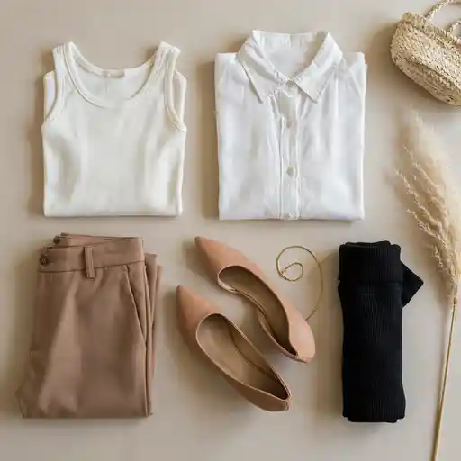
Minimalist clothing essentials for women can make getting dressed much easier. Instead of staring at a crowded closet, you can open the door and quickly find pieces that work together.
A minimalist wardrobe does not mean wearing only black, white, and gray. It also does not mean throwing away most of your clothes or buying expensive designer pieces. Instead, it means choosing clothing with care.
The goal is simple: own fewer pieces that you actually enjoy wearing.
Moreover, the best wardrobe should fit your real life. If you work from home, your needs will differ from someone who works in an office. Likewise, a woman living in a hot climate needs different fabrics from someone living in a cold place.
Therefore, this guide explains how to create a simple women’s wardrobe that feels stylish, comfortable, useful, and personal.
You will learn which basics matter most, how to choose colors, how to shop on a budget, how to avoid common mistakes, and how to create many outfits from a small number of clothes.
You will also find a wardrobe chart, real-life examples, advantages and disadvantages, expert advice, shopping tips, care advice, and 20 frequently asked questions.
What Minimalist Clothing Essentials for Women Really Mean
Minimalist clothing essentials for women are not a fixed list that every woman must follow.
Instead, they are the clothes that help you get dressed easily and handle the situations in your daily life.
For one woman, that may mean:
- Three simple T-shirts
- Two pairs of jeans
- One pair of trousers
- One cardigan
- One blazer
- Two dresses
- Comfortable sneakers
- Simple flats
- One everyday bag
For another woman, the list may look very different.
For example, a teacher may need comfortable trousers and smart tops. A stay-at-home parent may need washable clothes that move easily. Meanwhile, an office worker may need more formal clothing.
So, the best minimalist wardrobe starts with your lifestyle, not someone else’s checklist.
Why Minimalist Clothing Essentials for Women Make Daily Life Easier
A smaller wardrobe can remove many small decisions from your day.
First, fewer choices can make mornings faster. Instead of considering 40 tops, you may choose from five or six favorites.
Second, matching becomes easier when your clothes share colors and shapes.
Third, you can see what you own. As a result, forgotten clothes are less likely to sit at the back of the closet.
The Ellen MacArthur Foundation encourages a fashion system where clothing stays in use longer and products are designed for durability and reuse.
Therefore, buying fewer useful pieces and wearing them often fits well with a more thoughtful approach to fashion.
Minimalist Clothing Essentials for Women Start With Lifestyle
Before buying anything, ask yourself five simple questions:
- Where do I spend most of my time?
- What clothes do I wear every week?
- What weather do I live in?
- What colors do I enjoy?
- What clothing makes me feel comfortable?
These questions can prevent many bad purchases.
For instance, buying five formal dresses makes little sense if you rarely attend formal events.
Likewise, buying heavy wool sweaters may not work well if you live somewhere warm.
Your wardrobe should support your life.
It should not force you to change your life to match your clothes.
The 70/30 Rule for a Simple Women’s Wardrobe
A useful starting point is the 70/30 idea.
Think of about 70% of your wardrobe as easy basics and 30% as personal or fun pieces.
Your basic section might include:
- Plain tops
- Simple trousers
- Jeans
- Neutral skirts
- Cardigans
- Simple dresses
- Everyday shoes
Your personal section can include:
- Bright colors
- Prints
- Statement jewelry
- Trend pieces
- Special occasion clothing
- Interesting bags
This approach keeps your closet practical without making it boring.
Furthermore, you do not need to remove every item that does not look “minimalist.”
A bright red dress can still belong in a minimalist wardrobe if you love wearing it.
Minimalist Clothing Essentials for Women and the Perfect White T-Shirt
A simple white T-shirt is one of the most useful pieces you can own.
However, not every white T-shirt deserves a place in your closet.
Look for:
- A comfortable fabric
- A useful neckline
- A fit you like
- Enough thickness
- Strong seams
- Easy washing
- A length that works with your bottoms
You can wear a white T-shirt with jeans for a relaxed outfit.
Then, you can wear it under a blazer for a smarter look.
You can also tuck it into a skirt, layer it under a cardigan, or wear it with wide-leg trousers.
That is the real value of a basic: one item should create several outfits.
Minimalist Clothing Essentials for Women Need a Reliable Black Top
A black top can work across many situations.
Choose a simple design rather than a highly trendy one.
For example, a black crew-neck top can work with:
- Blue jeans
- Black trousers
- Beige pants
- A denim skirt
- A printed skirt
- A blazer
- A cardigan
You can also choose navy if black does not suit your personal coloring.
Remember, minimalist style is about simplicity, not strict rules.
Minimalist Clothing Essentials for Women and Better Jeans
Jeans often become one of the hardest-working items in a wardrobe.
However, finding the right pair matters more than owning many pairs.
Consider:
- Rise
- Leg shape
- Length
- Fabric stretch
- Wash
- Comfort
- Lifestyle
Straight-leg jeans are a strong starting point because they can work with sneakers, flats, boots, and many tops.
Wide-leg jeans can also work well if you enjoy a relaxed shape.
Meanwhile, a darker wash can look more polished, while a lighter wash often feels casual.
Do not buy jeans because someone says they are “the perfect style.”
Buy jeans because they fit your body and your life.
A Simple Trouser Formula That Works
Every minimalist wardrobe needs at least one pair of trousers that feels easy to wear.
Black trousers are a common choice.
However, navy, gray, beige, brown, olive, or cream can work too.
A useful trouser should work with at least three tops you already own.
Before buying, try different shoes with it.
Check whether the hem works with:
- Sneakers
- Flats
- Loafers
- Boots
- Sandals
If the trousers only work with one pair of shoes, they may not give you enough value.
Minimalist Clothing Essentials for Women and the Everyday Dress
A simple dress can save time.
You do not need to create a full outfit from several pieces. You can simply put on the dress and add shoes and accessories.
Choose a shape that fits your lifestyle.
Good options include:
- Shirt dresses
- Simple midi dresses
- Knit dresses
- Wrap-style dresses
- Straight dresses
- Relaxed cotton dresses
For warm weather, breathable cotton or linen can feel comfortable.
For cooler weather, a knit dress can work with boots and a jacket.
The most useful dress is one that can move between casual and slightly dressy settings.
The Button-Down Shirt Is More Useful Than It Looks
A button-down shirt gives you many styling choices.
You can wear it:
- Fully buttoned
- Open over a T-shirt
- Tucked into trousers
- Half-tucked into jeans
- Under a sweater
- Over a dress
- With rolled sleeves
White is classic, but blue, cream, and soft stripes can also work.
For a minimalist closet, choose a shirt that does not depend on one short-lived trend.
Minimalist Clothing Essentials for Women Need One Great Layer
Layers make simple clothes more useful.
A cardigan is an easy choice because it can add warmth without looking too formal.
A blazer gives a more polished look.
A denim jacket creates a casual feel.
A lightweight overshirt can work between seasons.
Therefore, think about layers based on your climate.
If you live in a hot area, choose breathable and lightweight layers.
If you live in a cold area, focus on sweaters, coats, and pieces that can work together.
Choosing the Right Neutral Colors
Neutral colors make mixing easier.
Popular choices include:
- Black
- White
- Cream
- Beige
- Gray
- Navy
- Brown
- Olive
However, you do not need all of them.
Choose two or three main neutrals.
For example:
Option A: Black + white + gray
Option B: Navy + cream + brown
Option C: Beige + white + olive
Then add one or two colors that you love.
This gives your wardrobe personality without making every outfit difficult to match.
Minimalist Clothing Essentials for Women Can Include Color
Minimalism does not mean removing color.
In fact, color can make a small wardrobe more enjoyable.
Suppose your basic colors are navy, cream, and white.
You could add:
- Red
- Soft pink
- Green
- Blue
- Yellow
- Burgundy
Choose one or two accent colors.
Then repeat them in small ways.
For example, a red sweater can work with blue jeans. A red bag can also work with a cream dress.
This creates a wardrobe that feels simple but not dull.
Build Around Three Main Outfit Groups
Instead of thinking about individual clothes, think about outfit groups.
Casual
- T-shirt
- Jeans
- Sneakers
- Crossbody bag
Smart casual
- Button-down shirt
- Trousers
- Loafers
- Simple jewelry
Dressy
- Midi dress
- Flats or low heels
- Small bag
- Jewelry
This method makes shopping much easier.
Whenever you consider a new item, ask:
Which outfit group will this improve?
If the answer is “none,” leave it in the store.
Minimalist Clothing Essentials for Women Should Match Your Shoes
Shoes can change an outfit completely.
However, shoes also take up space and can become expensive.
Start with useful pairs.
Everyday sneakers
Choose comfortable sneakers for casual outfits.
Simple flats
Flats can work with trousers, dresses, skirts, and jeans.
Loafers
Loafers can make basic clothes look more polished.
Sandals
Sandals are useful in warm weather.
Boots
A simple ankle boot can work across several seasons.
Occasion shoes
Keep one pair for weddings, parties, or formal events if you actually attend them.
You do not need ten pairs.
The Minimalist Bag Collection
A small bag collection can be enough.
Start with an everyday bag.
Then consider a smaller evening or event bag if your lifestyle requires one.
A useful everyday bag should hold what you actually carry.
Think about:
- Phone
- Wallet
- Keys
- Sunglasses
- Small makeup items
- Water bottle
- Work items
Choose a color that works with most of your wardrobe.
Black, brown, tan, navy, and cream are often easy choices.
Minimalist Clothing Essentials for Women and Simple Accessories
Accessories can make basic clothes look different.
You can use:
- Small earrings
- A watch
- A simple necklace
- A belt
- A scarf
- Sunglasses
- A small bracelet
For example, one white shirt can look different with a scarf, belt, necklace, or blazer.
Therefore, you do not always need another shirt to create a new look.
Sometimes, a small accessory can do the job.
How Many Clothes Do You Actually Need?
There is no perfect number.
One woman may feel comfortable with 25 pieces.
Another may need 50.
Your work, climate, laundry schedule, hobbies, family life, and social activities all matter.
A useful starting wardrobe might include:
| Category | Suggested Starting Range |
| T-shirts and basic tops | 4–6 |
| Blouses or button-downs | 2–4 |
| Jeans | 2 |
| Trousers | 2–3 |
| Skirts | 1–2 |
| Dresses | 2–4 |
| Cardigans/sweaters | 2–4 |
| Jackets/blazers | 1–3 |
| Everyday shoes | 3–5 pairs |
| Bags | 2–3 |
| Outerwear | 1–2 |
These numbers are only a starting point.
You can own less or more.
Minimalist Clothing Essentials for Women and the One-In, One-Out Rule
A useful way to control closet growth is the one-in, one-out rule.
When you buy a new basic, consider whether an old piece should leave.
For example, if you buy a new white shirt, you might donate an old white shirt that no longer fits well.
However, do not throw away good clothing just to follow a rule.
Instead, use the rule when your closet begins to feel full.
This keeps your wardrobe manageable over time.
The 30-Wear Test Before You Buy
Before buying something, ask:
Can I imagine wearing this at least 30 times?
You do not need to count every wear.
The question simply encourages you to think beyond the excitement of buying.
A trendy top may look great in the store.
Yet, if you can only imagine wearing it once, it may not be a good minimalist purchase.
On the other hand, a simple cardigan that works with jeans, trousers, skirts, and dresses could become a regular favorite.
Minimalist Clothing Essentials for Women and Fabric Choice
Fabric affects comfort, care, durability, and appearance.
Common choices include:
Cotton
Cotton is popular because it feels comfortable and works across many garments.
Linen
Linen can be excellent for warm weather because it feels light and breathable.
Wool
Wool can provide warmth in colder weather.
Cashmere
Cashmere can feel very soft, but it often needs careful care and can cost more.
Denim
Denim can last a long time when you care for it properly.
Synthetic fibers
Polyester, nylon, and other synthetic fibers can have useful qualities such as strength, stretch, and easy care.
There is no single “perfect” fabric.
Instead, choose fabric based on how you will use and care for the garment.
Check the Care Label Before Buying
A garment that needs complicated care may not fit your lifestyle.
For example, if you dislike hand washing, a delicate top may spend more time in your closet than on your body.
Care labels can tell you how to clean and maintain clothing. In the United States, the Federal Trade Commission requires covered clothing manufacturers and importers to provide care instructions or appropriate warnings.
So, always check the label before buying.
Ask yourself:
- Can I wash it easily?
- Does it need special drying?
- Will I actually follow the care instructions?
- Can I afford the care it needs?
A beautiful garment is not useful if you never want to care for it.
Minimalist Clothing Essentials for Women and Better Shopping Habits
Good minimalist shopping starts before you enter a store.
First, check your wardrobe.
Second, make a list.
Third, set a budget.
Fourth, identify the exact gap.
For example, do not write:
“Buy some clothes.”
Instead, write:
“Find one cream cardigan that works with my jeans, trousers, and dresses.”
That small change makes shopping more focused.
You are no longer searching for excitement.
You are solving a real wardrobe problem.
Avoid the “Just in Case” Shopping Trap
Many people buy clothes for imaginary situations.
They think:
- “Maybe I will attend a formal dinner.”
- “Maybe I will start wearing heels.”
- “Maybe I will go on a beach holiday.”
- “Maybe I will lose weight.”
- “Maybe this will become useful.”
Sometimes these things happen.
However, buying too many “maybe” clothes creates clutter.
Buy for your real life first.
Then add special items when you actually need them.
Minimalist Clothing Essentials for Women on a Small Budget
You do not need a large budget to create a simple wardrobe.
Start with what you already own.
Then repair useful pieces.
After that, replace only items that truly need replacing.
You can also shop:
- Secondhand stores
- Charity shops
- Clothing swaps
- Resale websites
- End-of-season sales
- Local markets
However, cheap does not always mean affordable.
A $10 shirt worn once costs more per wear than a $40 shirt worn 40 times.
So, think about cost per wear.
Simple formula
Cost per wear = purchase price ÷ number of wears
A $60 jacket worn 60 times costs $1 per wear.
A $15 top worn three times costs $5 per wear.
Therefore, the cheaper item is not always the better value.
A Real-Life Example: Maya’s 40-Piece Closet
Consider Maya, a fictional 31-year-old office worker.
Before simplifying her wardrobe, she owned about 80 clothing items.
Yet, she often said:
“I have nothing to wear.”
She started by tracking what she wore for one month.
She discovered that she regularly wore:
- Two pairs of jeans
- Two trousers
- Four tops
- One cardigan
- One blazer
- Two dresses
- Three pairs of shoes
She rarely wore most of her other clothes.
So, Maya did not immediately throw everything away.
Instead, she separated her clothing into three groups:
Wear often: pieces she loved.
Maybe: pieces she was unsure about.
Leave: items that no longer fit her life.
After a few months, she built a smaller working wardrobe.
The important lesson is not Maya’s exact number.
The lesson is that your real wearing habits reveal what belongs in your wardrobe.
Case Study: A Capsule Wardrobe for a Hot Climate
Imagine Sara lives in a warm and humid city.
She does not need a large collection of heavy sweaters.
Instead, her wardrobe could focus on:
- Cotton T-shirts
- Linen shirts
- Lightweight trousers
- Wide-leg pants
- Breathable dresses
- Cotton skirts
- Comfortable sandals
- Lightweight sneakers
- One thin cardigan for air-conditioned spaces
This example shows why a universal wardrobe list can fail.
Your climate matters.
Your daily movement matters.
Your workplace matters.
Your laundry routine matters too.
Therefore, build your wardrobe around the life you actually live.
Expert Advice: Think About Versatility First
Professional stylists often focus on versatile pieces because they make outfit building easier.
Recent stylist advice also emphasizes timeless fits, useful staples, quality materials, and clothing that matches the wearer’s lifestyle rather than chasing every trend.
A useful question is:
How many outfits can I make with this item?
If the answer is one, think carefully.
If the answer is five or ten, the item may deserve more attention.
However, versatility is not everything.
You must also like the piece.
A versatile item that you hate wearing is not a good essential.
Minimalist Clothing Essentials for Women and Personal Style
Minimalism should never erase your personality.
You can still have:
- Floral prints
- Bright colors
- Vintage pieces
- Fun jewelry
- Bold shoes
- Graphic T-shirts
- Statement jackets
The trick is balance.
For example, if you love bright shoes, keep the clothing simple.
If you love printed dresses, keep accessories quiet.
If you love colorful jackets, use neutral basics underneath.
This lets your personality stand out without making your closet hard to use.
The Three-Color Outfit Trick
A simple outfit often looks more connected when you limit the main colors.
For example:
Cream + brown + black
or
Navy + white + tan
or
Black + gray + red
You do not have to follow this rule every day.
Instead, use it when an outfit feels confusing.
Look at the clothes.
Pick one main color.
Add one neutral.
Then add one small accent if you want.
This is an easy way to make simple clothing look intentional.
Minimalist Clothing Essentials for Women for Work
A work wardrobe should match your workplace.
For a business-casual office, you might use:
- Two trousers
- One dark jean if allowed
- Three tops
- One blouse
- One blazer
- One cardigan
- Two pairs of smart shoes
- One simple dress
Then rotate combinations.
For example:
Monday: trousers + blouse + blazer
Tuesday: jeans + shirt + cardigan
Wednesday: trousers + T-shirt + blazer
Thursday: dress + cardigan
Friday: jeans + blouse + loafers
The same pieces can create many different outfits.
A Minimalist Weekend Wardrobe
Weekend clothing can stay simple.
You may need:
- Two pairs of jeans
- Three casual tops
- One relaxed shirt
- One casual dress
- One sweatshirt or cardigan
- Sneakers
- Sandals
However, your weekend wardrobe should reflect your activities.
If you hike every weekend, add outdoor clothing.
If you attend social events, keep one polished outfit.
Minimalism should never make your life harder.
Travel-Friendly Minimalist Clothing Essentials for Women
Travel becomes easier when your clothes mix well.
Try building a travel color group.
For example:
- Black trousers
- Blue jeans
- White shirt
- Black T-shirt
- Cream sweater
- Simple dress
- Sneakers
- Flats
Now most items work together.
You can also choose fabrics that do not wrinkle easily if that matters to you.
Before packing, create outfits rather than simply throwing clothes into a suitcase.
That approach helps prevent overpacking.
What Not to Buy for a Minimalist Closet
A minimalist wardrobe does not require a long “do not buy” list.
Still, watch out for:
- Poor fit
- Uncomfortable fabrics
- Items that match nothing
- Clothes you need to “fix” mentally
- Duplicate basics
- Extremely short-lived trends
- Clothes for imaginary lifestyles
- Items that require care you dislike
- Purchases made only because they are on sale
A sale is not a saving if you did not need the item.
Minimalist Clothing Essentials for Women and Seasonal Rotation
You do not need every season’s clothing in your main closet.
Instead, rotate less-used pieces.
For example, store heavy winter clothing during hot months.
Then bring it back when the weather changes.
This creates more space and makes your current wardrobe easier to see.
However, keep a few useful transition pieces available.
A lightweight cardigan, shirt, or jacket can work across several seasons.
The Closet Audit Method
Try this simple process.
Step 1: Remove everything
Take your clothes out if you have the space.
Step 2: Group similar items
Put all T-shirts together.
Then group jeans, trousers, dresses, and so on.
Step 3: Choose your favorites
Pull out pieces you wear often.
Step 4: Check fit
Set aside anything that no longer fits comfortably.
Step 5: Check condition
Look for holes, stains, broken zippers, and stretched fabric.
Step 6: Build outfits
Try combinations using your favorite pieces.
Step 7: Create a maybe box
Place uncertain pieces in a box for a few months.
This gives you time to decide without pressure.
Minimalist Clothing Essentials for Women and the Fit Test
Fit is often more important than the brand name.
When trying on a piece, move around.
Sit down.
Walk.
Raise your arms.
Check the shoulders.
Check the waist.
Check whether the fabric pulls.
If you feel uncomfortable in the fitting room, you may not enjoy wearing the item at home.
Also, remember that sizing differs between brands.
Do not become attached to a number on the tag.
Focus on comfort and fit.
How to Make Basic Outfits Look Better
Simple clothing can look polished when you pay attention to small details.
Try:
- Tucking in your shirt
- Rolling your sleeves
- Adding a belt
- Matching shoe and bag colors
- Wearing clean shoes
- Adding small jewelry
- Choosing the right proportions
- Keeping clothing wrinkle-free
These changes cost little or nothing.
Fashion does not always require new clothing.
Sometimes, styling what you already own creates the biggest improvement.
Advantages of a Minimalist Women’s Wardrobe
A minimalist wardrobe can offer several benefits.
Less decision stress
You have fewer choices each morning.
Easier outfit matching
Similar colors and simple shapes work together.
Lower spending
You may buy fewer unnecessary items.
More closet space
You can see your clothes more clearly.
Better use of favorite pieces
You are more likely to wear clothes you love.
Easier travel
Packing becomes simpler.
Less waste
Buying less can reduce the number of unwanted clothes entering your home.
The Ellen MacArthur Foundation notes that clothing use has fallen while production has increased, which highlights why keeping garments in use longer matters.
Disadvantages You Should Know
Minimalism is not perfect.
There are some downsides.
You may feel limited
A very small wardrobe may feel boring.
Laundry can increase
If you own fewer clothes, you may wash them more often.
Special events can be difficult
You may need occasional pieces for weddings or formal events.
Weather changes can cause problems
You need enough clothing for the seasons.
Trends may feel less exciting
You may buy fewer trendy pieces.
Mistakes can cost more
If you own only a few trousers, buying the wrong pair matters more.
Therefore, do not aim for the smallest possible wardrobe.
Aim for the smallest wardrobe that comfortably supports your life.
Minimalist Clothing Essentials for Women and Sustainable Choices
Buying less is one useful step.
However, how you care for clothes matters too.
Repair a loose button.
Fix a small tear.
Clean shoes instead of replacing them.
Follow washing instructions.
Donate or resell wearable clothing when you truly no longer need it.
The Ellen MacArthur Foundation’s circular fashion work focuses on keeping products and materials in use and designing clothing for longer use, repair, and future reuse.
So, a minimalist wardrobe can support a more thoughtful relationship with clothing.
A Better Way to Judge Clothing Quality
Price alone does not tell you whether clothing is good quality.
Instead, check:
- Seams
- Buttons
- Zippers
- Fabric feel
- Stitching
- Lining
- Shape
- Transparency
- Fit
Look closely at areas that receive stress.
For trousers, check the waistband and seams.
For jackets, check the shoulders and lining.
For shirts, check the collar and buttons.
Also, think about how often you expect to wear the piece.
The Five-Minute Outfit Planning Method
If you struggle to dress in the morning, plan five outfits once a week.
Choose:
- One top
- One bottom
- One layer
- One pair of shoes
- Optional accessories
Take a quick photo.
Then, when morning arrives, you already have an idea.
This is especially useful for busy work weeks.
Moreover, the photos show which pieces work well together.
After several weeks, you may notice your favorite combinations.
Those combinations can become the foundation of your wardrobe.
Minimalist Clothing Essentials for Women: A Complete Starter Checklist
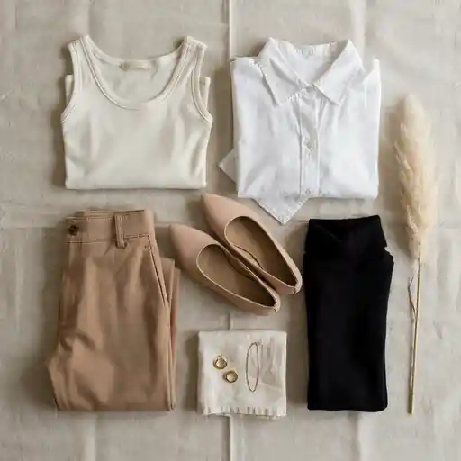
Here is a practical starter checklist.
Tops
- ☐ 2 white or cream tops
- ☐ 1 black or dark top
- ☐ 1 colored top
- ☐ 1 button-down shirt
- ☐ 1 nicer blouse
Bottoms
- ☐ 1 straight-leg jeans
- ☐ 1 second pair of jeans
- ☐ 1 black or dark trouser
- ☐ 1 light or neutral trouser
- ☐ 1 skirt if you wear skirts
Dresses
- ☐ 1 everyday dress
- ☐ 1 dressier option
Layers
- ☐ 1 cardigan
- ☐ 1 blazer or jacket
- ☐ 1 seasonal layer
Shoes
- ☐ Everyday sneakers
- ☐ Flats or loafers
- ☐ Sandals
- ☐ Boots or occasion shoes, depending on your lifestyle
Accessories
- ☐ Everyday bag
- ☐ Small bag
- ☐ Belt
- ☐ Simple jewelry
- ☐ Sunglasses
This list is flexible.
Remove what you never wear.
Add what your lifestyle truly needs.
Minimalist Clothing Essentials for Women: Your 30-Day Challenge
If you want to start today, try this 30-day plan.
Days 1–5: Observe
Do not buy anything.
Simply notice what you wear.
Days 6–10: Sort
Group your clothing.
Remove obvious items that no longer fit or work.
Days 11–15: Build outfits
Create at least ten combinations.
Take photos if helpful.
Days 16–20: Find gaps
Look for genuine problems.
Maybe you need one good pair of trousers.
Maybe you need a simple cardigan.
Maybe you need comfortable shoes.
Days 21–25: Shop carefully
Buy only what solves a real problem.
Days 26–30: Review
Ask:
- What did I wear most?
- What did I ignore?
- Which colors worked?
- Which pieces felt uncomfortable?
- What do I still need?
This process helps you create a wardrobe based on evidence instead of guesswork.
Frequently Asked Questions
- What are the most important minimalist clothing essentials for women?
The most important pieces usually include comfortable tops, jeans, trousers, a versatile dress, a layer, practical shoes, and a useful bag. However, your exact list should match your lifestyle.
- How many clothes should a minimalist woman own?
There is no universal number. Some women feel comfortable with 30 to 40 clothing pieces, while others need more because of work, weather, hobbies, or family life.
- Does a minimalist wardrobe have to be black and white?
No. Minimalism is about simplicity and usefulness, not a specific color palette. You can use navy, beige, brown, olive, pink, red, blue, or any colors you enjoy.
- Can minimalist clothing essentials for women include trendy clothes?
Yes. A few trend pieces can add personality. The key is to avoid filling your closet with trends that you rarely wear.
- What is the best color for a minimalist wardrobe?
There is no single best color. Black, navy, beige, cream, white, gray, and brown are easy to mix, but you should choose colors you enjoy wearing.
- Are expensive clothes better for a minimalist wardrobe?
Not always. Price does not guarantee quality. Look at fit, fabric, construction, comfort, and expected use.
- How can I build a minimalist wardrobe on a budget?
Start with what you own. Repair useful clothing, shop secondhand, create a shopping list, and buy only pieces that fill real gaps.
- What should I buy first?
Start with the clothes you wear most often. If you wear jeans every week, begin with a great pair. If you work in an office, prioritize useful work basics.
- Are dresses essential in a minimalist wardrobe?
Not for everyone. If you rarely wear dresses, you do not need several. However, one versatile dress can be useful if it fits your lifestyle.
- How do I stop buying clothes I do not need?
Use a waiting period. Put the item on a list and wait a few days before buying it. Also ask how many outfits you can create with it.
- Should I get rid of all clothes I have not worn recently?
Not necessarily. Seasonal clothing, special occasion pieces, and sentimental items may have value. Instead, separate them from your everyday wardrobe.
- What is the difference between a capsule wardrobe and a minimalist wardrobe?
A capsule wardrobe is usually a small group of coordinated clothing designed to create many outfits. A minimalist wardrobe is a broader idea focused on owning fewer useful possessions.
- How can I make basic clothes look stylish?
Focus on fit, proportions, clean shoes, simple accessories, and good layering. Small styling changes can make basic clothing look much more polished.
- How often should I replace wardrobe basics?
Replace them when they no longer serve you. Look for damage, poor fit, fading, stretching, or discomfort instead of replacing clothes simply because a certain amount of time has passed.
- Are neutral colors necessary for minimalist clothing essentials for women?
No. Neutral colors simply make matching easier. You can create a minimalist wardrobe with bright colors if you keep your shapes and outfit combinations simple.
- What shoes should every minimalist woman own?
A useful starting group includes comfortable everyday sneakers, flats or loafers, sandals if needed, and boots or occasion shoes based on your climate and lifestyle.
- Can minimalist wardrobes work for plus-size women?
Absolutely. Minimalism works with every body shape. Focus on comfortable fits, useful colors, flattering proportions, and clothes that make you feel good.
- How can I make my minimalist wardrobe more feminine?
You can use dresses, skirts, soft colors, jewelry, scarves, curved shapes, or delicate shoes. Minimalism does not mean choosing only masculine or boxy clothing.
- Is buying secondhand good for a minimalist wardrobe?
Yes, especially when you find durable pieces that fill real wardrobe gaps. However, secondhand shopping can still become excessive if you buy items simply because they are cheap.
- What is the biggest minimalist wardrobe mistake?
The biggest mistake is copying someone else’s wardrobe exactly. Your wardrobe should serve your body, lifestyle, climate, budget, work, and personal taste.
Final Thoughts: Build a Wardrobe That Works for You
The best minimalist clothing essentials for women are not the same for everyone.
Your ideal wardrobe should make your mornings easier.
It should help you feel comfortable.
It should support your work and personal life.
It should also give you enough variety to enjoy getting dressed.
Most importantly, do not rush.
Start with the clothes you already own.
Notice what you wear.
Find the gaps.
Then shop slowly.
A simple wardrobe does not require perfection. It requires good choices made again and again.
As you build your closet, remember one simple rule:
Buy less, choose better, and wear what you love.
That idea can help you create a wardrobe that stays useful long after today’s fashion trends disappear.
Recommended External Resources
For readers who want to learn more about clothing care, circular fashion, and responsible wardrobe use, these are useful starting points:
- Federal Trade Commission — Clothing Care Labels — useful for understanding garment-care instructions.
- Ellen MacArthur Foundation — Circular Economy for Fashion — explains how fashion can move toward longer use, repair, reuse, and better product design.
- Ellen MacArthur Foundation — A New Textiles Economy — provides broader background on clothing production, use, and waste.
- Ellen MacArthur Foundation — Designing Products to Be Used More and for Longer — useful for learning why durability and long-term use matter.
- Ellen MacArthur Foundation — Circular Business Models for Fashion — covers repair, resale, rental, and other approaches that can keep clothing in use longer.